
Creating a Team Structure Generation Z Will Love

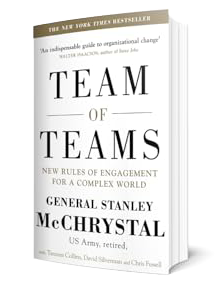
Nearly ten years ago, General Stan McChrystal took what he learned leading the Joint Special Operations Task Force and applied it to the businesses in Team of Teams: New Rules of Engagement for a Complex World, a New York Times bestseller.
While serving in Iraq, General McChrystal observed something frustrating yet fascinating. During that season, the smaller Iraqi troops were beating his larger U.S. army. For example, the moment the U.S. forces took out an Iraqi general, five others would instantly hop up and take over. Communication was instant and fluid. Nothing seemed to slow them down. They were agile and remained in battle far longer than anyone expected. In contrast, the U.S. military practiced a top-down organization of officers, that bogged down information between enlisted soldiers and officers. In fact, while the structure was clear and understandable, it slowed their progress.
To thrive in complexity, organizations must evolve from rigid, command-and-control structures to agile "teams of teams" by fostering shared consciousness, open information sharing and swift execution through decentralized decision-making.
From Command to Collective
This is energizing for Generation Zers. In fact, it is live giving. Those over 45 years old must remember, Gen Z has been conditioned by technology on how to perform. Their world has no top-down authority structure. It’s decentralized. They’re conditioned by Web 3.0. They are “wiki” contributors who care little about status. This is confounding to older generations accustomed to organizational charts and chains of command—but Gen Z is the future.
At the same time, the screens that Generation Z has grown familiar with has induced a level of loneliness like we’ve not seen in my lifetime. Certainly, their screens are not the only culprit, but a growing body of research shows the expansion of screens has led to the increase of young people spending time apart from each other and forming an artificial community, not an authentic one. Small work teams can change this.
Three Key Elements
1️⃣ A common goal and adversary.
Like a military troop, these teams must be clear on their objective and motivated by overcoming an adversary. The “goal” must be measurable and attainable. The “enemy” may be your industry competition, or it could be last year’s outcomes. It may even be fuzzy thinking, apathy or lack of productivity. When teams are clear—results are near.
2️⃣ Interdependence.
General McChrystal clarifies how companies must transition from rigid, traditional structures to adaptive, interconnected networks to flourish in our unpredictable world. He proposes creating a “shared consciousness” through open communication and strong inter-team relationships to empower execution. This model enables faster, more informed decision-making, increased adaptability, and resilience, allowing diverse teams to function interdependent on one another.
3️⃣ Flat systems of communication.
Generation Z will love this set up, as they were trained by technology, where there is little if any structure in their learning journey on a portable device. Systems were more organic, not as confined by structure. Communication then becomes more about permission not about position. Much has been written about the corporate ladder become a lattice, and that’s essentially what people will enjoy in this system.
I find it amazing that people naturally migrate toward this model in times of crisis. They suddenly don’t care about titles or hierarchy. Why? Crises give us perspective. I recently read about the Spring Hill Coal Mine disaster that took place in October of 1958. This coal mine experienced a “bump” causing a collapse and instantly killing 74 of the 174 men inside. It was a coal miners’ worst nightmare. There were three groups trapped inside that had no contact with each other—but a common goal: they all wanted to survive.
A study called, “Individual and Group Behavior in a Coal Mine Disaster,” later revealed how all but one of the remaining coal miners were rescued. Two kinds of leaders emerged without any titles or badges. The first group were all about solving the problem. Their people skills were low, tempers were short, and patience grew thin, but they worked tirelessly on getting everyone out. As several of their solutions failed, however, another group of leaders emerged, who focused on serving people. They recognized the need to keep morale high, energy up and hope alive. They found ways to communicate. In the end, everyone agreed that both of those kinds of leaders were necessary:
Those who focused on solving the problem.
Those who focused on serving the people.
My friend Ken Blanchard said, “None of us are as smart as all of us.” The key is to get “all of us” collaborating equally on solving problems and serving people.
Find insights like these in my new book that just released:

The Future Begins with Z:
Nine Strategies to Lead Generation Z as They Disrupt the Workplace.
Now available wherever you buy books
Bonus materials are available, when you order!
Subscribe to future articles from Tim.
Book Tim for an event.